

You have an offer
Someone wants to buy your business.
The headline price is not what lands in your account. See what the offer pays you after tax, debt, fees, and structure, and what the buyer will look for before closing.
Deals do not die at the handshake. They die in diligence: the owner the business cannot run without, the add-back that fails, the contract that does not transfer, the revenue a buyer will not count. Exit OSx runs the buyer's checks on your business now, prices every finding in deal terms, and tells you whether to go to market, fix something first, or wait.
Free · Six questions, about 90 seconds · No account needed. You get a value range and the two things a buyer would push on first.
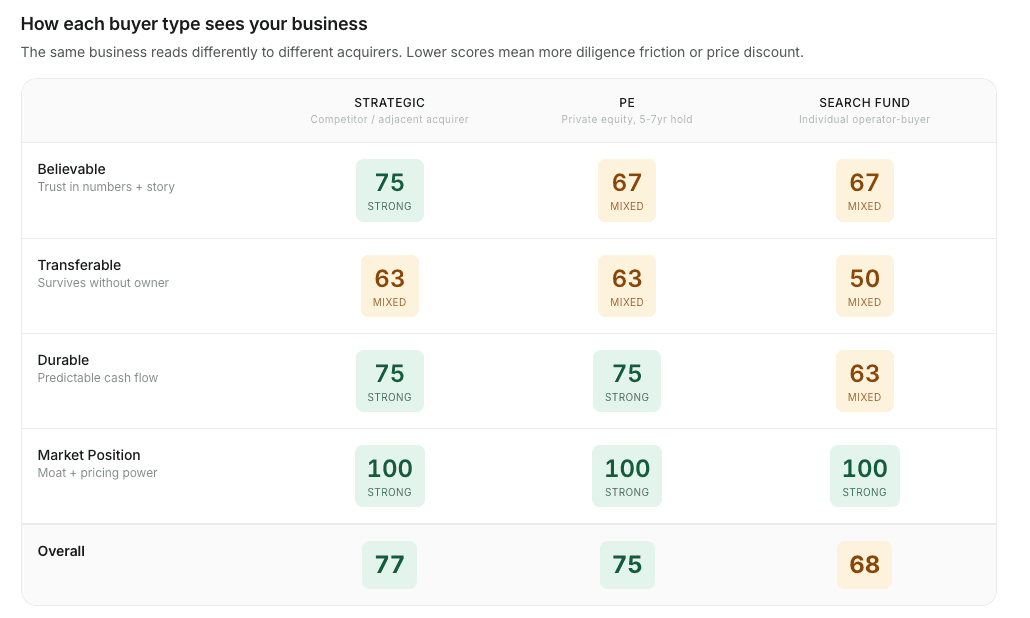
Three buyer types. Three different reads of the same business.
Where deals die
of dead deals died on what diligence found
a private equity buyer sits in exclusivity before walking away
sale processes end without a deal
of recent sellers wish they had started preparing earlier
Sources: Axial Dead Deal Report 2025 (75 failed LOIs) · Pepperdine Private Capital Markets Report 2025 · UBS Investor Watch 2023 (123 recent sellers)
The headline price is not what lands in your account. See what the offer pays you after tax, debt, fees, and structure, and what the buyer will look for before closing.
Run the checks a buyer's team will run, see what each finding does to your price, and get a verdict: go to market, fix something first, or wait.
A buyout needs a number both sides can live with and terms both sides understand. Get a three-method valuation with every input shown, then model the deal.
Grade every client the way a buyer will, under your brand, before an unprepared seller costs you a dead deal or a re-trade.
A buyer's team will spend 60 to 120 days on your business under exclusivity, while your leverage falls every week. Exit OSx front-loads that work to a time when you can still act on it.
Six questions, about 90 seconds, no account, no card. You see the band a buyer would start from and how wide it is.
The same six answers also give you the two findings most likely to move your price, and what each one does to it. Save it, still with no card.
Every check a buyer's team runs, graded the way they grade it. Answers backed only by your word count at a discount until the record is in. Criticals cap the rating until they are cleared.
A verdict with a date, not a dashboard. Go: run a process and price what is left. Fix: close these first, in this order. Wait: a failed process burns your buyer list.
Most readiness tools give you a score. A buyer does not care about your score. A buyer turns each finding into one of six things, and Exit OSx tells you which one, for every check, before you are across the table.
Most owners negotiate the headline number and then find out how little of it arrives on closing day. Exit OSx grades you separately for each buyer type and shows what that buyer typically puts on paper, so you can see the trade before you pick a lane.
A competitor or adjacent acquirer
95% cash at close, 5% earnout over 2 years
Buying something they would otherwise have to build: your customers, your territory, a capability that plugs into what they run. They can pay the most because you are worth more inside their company than standing alone.
Watch out. The most cash of the three, and the deepest scrutiny of whether your contracts actually assign to a new owner.
A financial sponsor, 5 to 7 year hold
60% cash at close, 15% rolled into their newco, 20% earnout over 3 years, 5% seller note
Buying a platform they can lever, grow, and sell again. The price follows what a lender will finance, which makes predictability worth more to them than upside.
Watch out. The headline number is not the number. Two fifths of it depends on their plan working, and a quality of earnings review will test every add-back you have taken.
An individual operator-buyer, SBA financed
50% cash at close, 30% seller note at 7% over 7 years, 15% earnout, 5% rollover
One person buying a job and an asset at once. The deal is financed rather than funded, so what a bank will lend against you matters more than what you are theoretically worth.
Watch out. The longest tail. A note this size means you are financing your own exit and carrying the buyer's execution risk for years.
Typical lower-middle-market terms, drawn from BVR and Pratt’s Stats commentary and the Axial deal-terms surveys. Starting points you tune against your own situation inside the product, not a prediction about your deal.
A valuation on its own is trivia. The question underneath it is whether the sale funds the rest of your life, and no business number answers that by itself. Exit OSx carries your personal balance sheet, your retirement model, and your company valuation in one place, because the gap between them is the whole decision.
Price, less debt, less fees, less tax, less what sits in escrow or earnout. The number that lands in your account, by buyer type and by state.
What the business has to sell for, after tax, to fund the life you want. Almost nobody has calculated it, and it is the only number that decides anything.
The distance between what you keep today and what you need. That gap decides whether you can afford to sell yet, and what has to change before you can.
Every unprepared seller costs you a dead deal, a re-trade, or a senior partner's month. Exit OSx grades every client the way a buyer will, under your brand, on the diagnostic, the valuation, and every report. Priced in the open: no quote call, no annual lock-in.
See the advisor program →You already hold the books. Exit OSx turns them into the valuation, the diligence read, and the after-tax answer the client is about to ask you for, under your firm's name, from the QuickBooks data already in your practice.
See how CPA firms use it →You see your buyer scorecard and a value range before you pay anything. The 14-day free trial opens the full diligence, then $199/mo billed yearly ($2,388/yr) or $249/mo monthly. In a deal right now? The monthly plan covers you from offer to close, then stop. Advisor accounts $399/mo billed yearly or $499/mo monthly (includes 1 client), plus $149/mo per additional client. Cancel anytime.